How Koreans become #1 in global sales
What was discussed

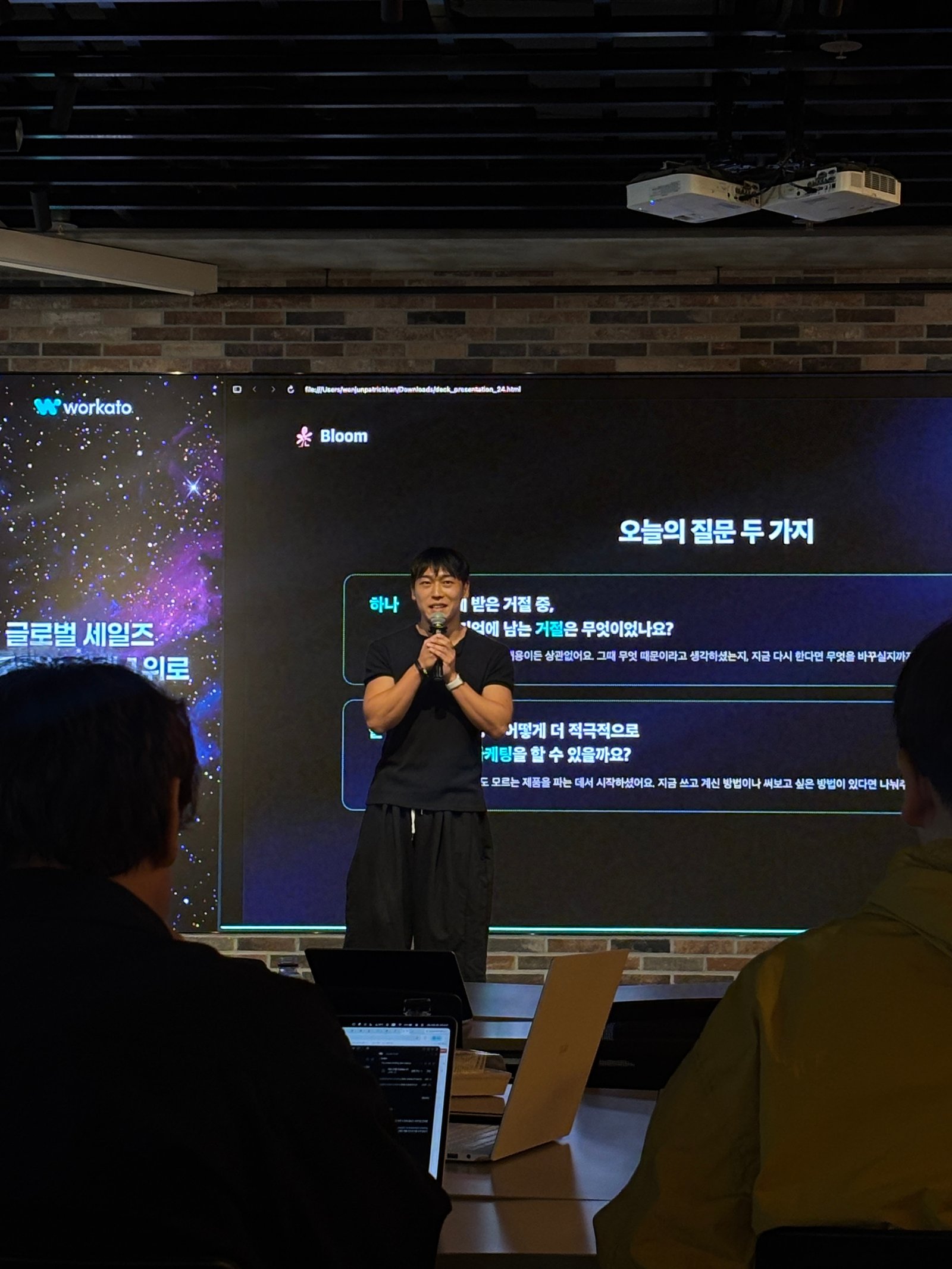
A meetup with Son Ye-jin of Workato and Kim Sang-chul, who goes by Yeoul, CTO of ThePlato, the team behind Tiro. One is taking a Korean startup into Japan and the US; the other opened the Korean market for a global company. Opposite directions, and the same place where each one decided to compete.
Yeoul opened. Tiro started as AI meeting notes and now positions itself as a product that turns conversation into an asset. Anyone can build a meeting-notes app at this point, and selling one into the enterprise means clearing a separate set of hurdles. This team went straight at them instead of around.
You never forget your first B2B customer, he said. Last year, as every large company was standing up an AX division, a team lead who had been using it as a consumer got in touch about adopting it across the org. They got lucky in that meeting notes is a product where a professional's time is payroll, so the return shows up immediately. But B2C and B2B run on completely different logic. B2C is try it, like it, pay. B2B is a game of filtering out reasons to say no. Without security certification you are cut regardless of how much anyone likes the product, so they spent six months passing a 200-item security review.
We asked why a startup would choose that path. He had concluded early that the technique of building software fast is losing its moat. So where is the moat? His read was that the security review and the enterprise sales process, the very hurdles wearing them down with checklists, might be the moat itself. Break through once and the next ones come flooding in.
There was a reason a Korean startup raised in Japan first. Working from the conviction that the product had to be global from the start, they narrowed by time zone, travel distance, and cultural region, which left Japan and the Middle East, and they picked Japan. One co-founder has since moved to Tokyo outright. Delighting your first handful of customers means living where they live, which he said is the same logic that has grown the product all along.
The main session was Son Ye-jin, who had gone to sleep at 5:30 that morning and caught a 10:30 flight out of Singapore. She was born and raised in Korea, landed a Boeing internship by chance that took her to the US for the first time, and built her career in Singapore afterward. Six years into a large company she felt herself falling behind and decided to move, pulled a full list of Singapore's Series C, D, and E companies, and landed at Workato. Nobody telling her what to do and everyone expecting results turned out to suit her.
She started as a solutions consultant, and Korean sales began with someone saying that since she spoke Korean she should try selling. The most practical thing she shared came out of that: relentlessly digging into what she did not know. She kept playing call recordings from salespeople worldwide, stored in the company's meeting tool, on the treadmill in the morning, over meals, in taxis, absorbing how other markets pitch.
Korean sales came down to finding the problem that only Workato can solve, and this was the sharpest framing of the night. If a customer has 500 problems, plenty of them can be solved with Workato, but 490 can be solved with something else too. Of the remaining ten, maybe one is worth paying this price for, and sales is the work of finding that one.
The story of hitting number one globally started with a leader in Singapore needling the team with a question. To a team saying that 100,000 to 200,000 dollars is a big deal in SaaS, he asked why a million-dollar deal was off the table. The team worked backward from the fact that a customer spending that much needs to see more than ten times the return. The answer turned out to be in interactions with existing customers. It started with not letting a trusted customer's offhand question slide, and instead booking a meeting to ask why they were asking. Asked what the company does for you after a deal that size, her answer was that it was genuinely hard. A customer investing that much has expectations to match, so closing was the starting line.
In the first half of this year alone she took first meetings with 50 enterprises. What she saw holding Korean corporates back was problem definition and change management. Defining what to do and what return it produces is difficult, and change management was the part that got the most nods in the room. The AX we picture is building something with Claude Code; the AX a frontline worker pictures is having to think a little less in the Excel window they stare at all day. Walk in with a solution without understanding that spectrum and you will take many meetings and close nothing.
Her answer on work-life balance was the most candid of the night. She said she wonders too, that burnout arrived and she is still running without having recovered from it, so she has no good advice. She did add that colleagues who help you get back up, and small goals, give you the footing to work through it very slowly. Asked how global companies see Korea now, she said that looking at East Asia from the US, Korea's purchasing power has started showing up in the numbers. These are people who do not move until it shows up in numbers, and the decision to open a Korean office took four years.
The roundtable topic was the most memorable rejection you have received recently. Someone who teaches AI had gone from complaints to make it easier to requests to make it more technical, and took from it that you show the output first and start teaching after. One table with no sales people expanded the concept instead: if sales is an exchange of value, then a compliance officer is marketing themselves in the broad sense too. Someone pushing AX internally shared that convincing their own developers is the hardest part.
The two speakers were pointed in opposite directions and competed in the same place. Tiro made the security reviews and enterprise sales process everyone avoids into its moat, and Workato spent its time finding the one problem out of 500 that only it could solve. Neither won on product features; both won at the hurdle nobody wants to climb. And both of them ended up living in the country. For one, a co-founder moved to Tokyo. The other put her child to bed and caught a night flight.
Read the full write-upEvent video
Gallery








Next event